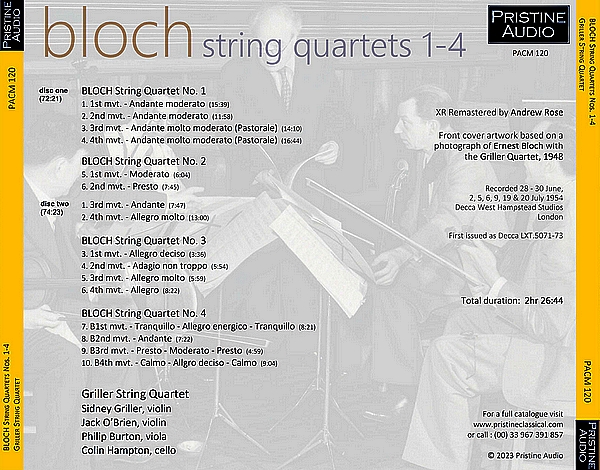
Pristine Audio PACM120
Griller String Quartet

Sidney Griller, violin
Jack O’Brien, violin
Philip Burton, viola
Colin Hampton, cello


XR Remastered by Andrew Rose
Front cover artwork based on a photograph of Ernest Bloch with the Griller Quartet, 1948
Recorded 28-30 June, 2, 5, 6, 9, 19 & 20 July 1954
Decca West Hampstead Studios, London
First issued as Decca LXT.5071-73
Total duration: 2hr 26:44

Disc one (72:21)

String Quartet No. 1

  1. 1st mvt. - Andante moderato (15:39)
  2. 2nd mvt. - Andante moderato (11:58)
  3. 3rd mvt. - Andante molto moderato (Pastorale) (14:10)
  4. 4th mvt. - Andante molto moderato (Pastorale) (16:44)

String Quartet No. 2
  5. 1st mvt. - Moderato (6:04)
  6. 2nd mvt. - Presto (7:45)

Disc two (74:23)

  1. 3rd mvt. - Andante (7:47)
  2. 4th mvt. - Allegro molto (13:00)

String Quartet No. 3
  3. 1st mvt. - Allegro deciso (3:36)
  4. 2nd mvt. - Adagio non troppo (5:54)
  5. 3rd mvt. - Allegro molto (5:59)
  6. 4th mvt. - Allegro (8:22)

String Quartet No. 4
  7. 1st mvt. - Tranquillo - Allegro energico - Tranquillo (8:21)
  8. 2nd mvt. - Andante (7:22)
  9. 3rd mvt. - Presto - Moderato - Presto (4:59)
10. 4th mvt. - Calmo - Allgro deciso - Calmo (9:04)

The four string quartets of Ernest Bloch form a group comparable in stature only with those of Bartók and of Beethoven. They have followed one another at an ever-increasing speed, as if impelled by an ever-increasing urge: the First Quartet came in 1916; the Second in 1945; the Third in 1953; and now already the Fourth. And during the long gap between the First and Second Bloch by no means entirely neglected the string quartet; it was allowed, in its customary uneasy partnership with the piano, to contribute to the monumental Piano Quintet of 1924.

In 1916 Bloch left Switzerland to go to the United States as conductor for a tour of the dancer Maud Allan. He stayed in America to make it his home: and the score of the First String Quartet, of 1916, is annotated Geneva—New York. That such a work can be written at all is one of the marvels of humanity; that it could be written during what must have been a period of complete personal upheaval is next to unbelievable. It is in writing of Bloch’s Second Quartet of 1945 that the late Beethoven quartets are most often drawn on for comparison; but they come to mind no less in considering the earlier work. It is on the largest of scales (Decca have here put more music, in duration, to a side than elsewhere perhaps they would like us to believe possible!); four long movements in the highest degree of concentration, with never a moment’s emotional relief. Here and there the Jewish idiom is faintly echoed, but the savagery that it sometimes brings in its train is the only interruption to the sorrow, and occasionally the tranquillity, that finds most moving expression in the rest of the heartfelt work.

Both the Third and the Fourth Quartets are on a smaller scale, in point of actual size. They are of a considerable intensity, but an intensity more frequently alleviated in tranquillity than previously. And there is, too, anything but a diminution of vigour: the outbursts of hard, biting determination are more frequent than in the earlier works, and contrasting sections frequently alternate — as they do often in late Beethoven — rapidly and effectively.

Listeners familiar with the Griller Quartet’s fine 78 set of the Second Quartet, or with their earlier LP of the Third, will know the standards of performance to be expected in these new issues. Everywhere there is almost impeccable ensemble, and also the deepest sensitivity; Bloch’s sustained elegiac moods are presented wholly without flagging of any sort. Some of the long-held diminuendos at the ends of phrases or of sections are played with seemingly superhuman control.

The recording, too, is in the first class. Occasionally in balance, in the First Quartet, the viola is allowed to be slightly backward; only once seriously so, and that for precisely two notes — to mention them at all is to risk a faulty emphasis. The quartet’s tone as a whole is unified in sound: in the First Quartet, again, a dark grey that might be thought to be due to faintly undernourished recording until in contrast it suddenly shines forth in one of Bloch’s few outbursts. The dark grey quality (but not the unification of tone) disappears with the greater brilliance of the later quartets: in the case of the Third there was more roundness, less brilliance of tone on the older LP, and perhaps a smoother performance. But the two new records are both contributions to the repertory of incalculable value offering entirely worthy performances of three unquestionable masterpieces: the fullest recommendation, with no reservations at all. A new recording of the Second Quartet by the Grillers is promised for release in the near future.

M.M., The Gramophone review of LP issues of Quartets 1, 3 & 4
Back in college when I was discovering the chamber music repertoire, there were two string quintets that reached out and grabbed me by the scruff of the neck: the Schubert C major, D.959, and the Mozart G minor, K.516. Both of them I first heard on LP in performances by ensembles whose recordings survive to this day, still at the pinnacle of interpretative perfection. The Schubert recording was made by the Hollywood String Quartet plus Kurt Reher in 1950 and blessedly survives on a Testament CD, SBT 1031 (see footnote below). Its adagio would mark a transformation in my later life, but that’s another story.
The recording of the Mozart with which I first became familiar was by the Griller Quartet plus Max Gilbert for Decca way back in 1948. Originally released on three 78s, it came out subsequently on an LP, LXT 2515. I still have my original copy, heavy and stiff as a shellac 78. Fortunately the Grillers recorded it again in 1959, along with the other five, when the technology was infinitely better. Vanguard Records were able to use the university’s wonderful new recital venue, Hertz Hall. I was working in the Music Library next door and so I was able to slip across for most of the recording sessions. Available on two Vangaurd CDs, ATM-CD-1204, it was history in the making: Classics Today wrote, “Without a doubt, this is one of the most important chamber music recordings ever made.” An extravagant claim, which I’m not inclined to argue with. But years later I would discover the performances of these quintets by the “Completed” Tatrai Quartet on the Hungarian Qualiton label, LPX 11438-40. (So far as I’ve been able to determine, it was never released, at least as a set, on CD.) They give the Grillers a run for their money, particularly in the later K.593 quintet. What they most importantly demonstrate is that the concept of the “definitive performance” is utter rubbish. How could four human beings who had lived through the second world war in central Europe, and came together immediately after it had ended, play this classically restrained but heart-rending music in the same way as an English quartet whose lives had been, by comparison, relatively tranquil? And who would want to live without either set of performances? But back to the Grillers. I was close enough to them to observe how a quartet of musicians could work together for over thirty years without becoming enmeshed in each others lives. (The attempt to do so often leads to both personal and musical disaster.) Sidney Griller was a family man, married in 1931 at the age of twenty to Honor Linton, with whom he lived his entire life and raised a couple of children. In later years, back in London and teaching at the Royal Academy where he had begun his training, he and Honor would maintain their lifelong reputation for hospitality. Second violinist Jack O’Brien and violist Philip Burton were “confirmed bachelors” (the phrase used in those circumlocutory days). I first knew them in 1953 when as a student at Cal I occupied a bed-sitter tucked under a massive redwood house on Shasta Road in the Berkeley hills. It was one of three such houses built on an enormous, mostly wild hillside plot by a retired British engineer named Andrew Shirra Gibb. He and his wife occupied one, I was under the second which was unoccupied, and Jack and Philip had the third . Gibb's guiding principles are set forth in Charles Keeler’s The Simple Home. Polymath Gibb later wrote a huge book which attempted to explain Jungian psychology to the general reader. Of the four quartet members, Philip was the scholar. His enormous library of Shakespeariana lined the walls of their living room. He was also a James Joyce enthusiast and told me of having encountered a Dublin taxi driver who had read all of Finnegan’s Wake. “It’s easy if you’re from these parts,” he had said. “It’s the way we talk.” When Andrew died, he left the property to Jack and Philip. The hillside plot had become a wildlife sanctuary, and it was their collective wish that, valuable as it would have been if split into building sites, it should be preserved intact. When I visited Jack in the 90s, Philip had died and he was living alone. The grounds were much as I remembered them, though a little wilder, and Philip’s library still lined the walls of the living room. Jack seemed touchingly grateful to talk to someone who had known them together some forty years before. The fourth member of the quartet was the cellist Colin Hampton. A somewhat mournful creature, he lived alone. One of his students was a rather plain girl named Bonnie Bell. A Paolo and Francesca romance gradually developed between them -- their eyes met, they kissed, and they read no more that day – but with a happy ending. Colin’s face became wreathed in smiles and Bonnie, who soon became Bonnie Hampton, blossomed into a truly beautiful woman with a distinguished career in her own right as performer and teacher. Such liaisons across the years can indeed produce miraculous results. Valerie Eliot, when I knew her fifteen years ago, still radiated the magnetic intensity which had given such joy to her beloved Tom and which she devoted to organizing his life and later his literary estate. The quartet disbanded in 1961 after Philip's death and in 1964 Sidney was invited by his alma mater, the Royal Academy, to come back to London and teach chamber music performance. I followed two years later as Pacifica Radio’s London Correspondent, but I never got in touch with him until 1993, when I noted in the Guardian birthdays list that he was exactly twenty years and four days older than me. On a whim I phoned to offer my congratulations. He remembered me immediately and urged me to phone again and set a date to come around for tea. It’s one of my regrets (I have so many!) that I never got around to doing so. In November he died at eighty-two (only three years older than me!), the last surviving member of his great eponymous quartet. This vignette is a small attempt to help prevent their memory, as people as well as musicians, from dying along with them. John Whiting, 2010 https://www.kpfahistory.info/music/griller.html

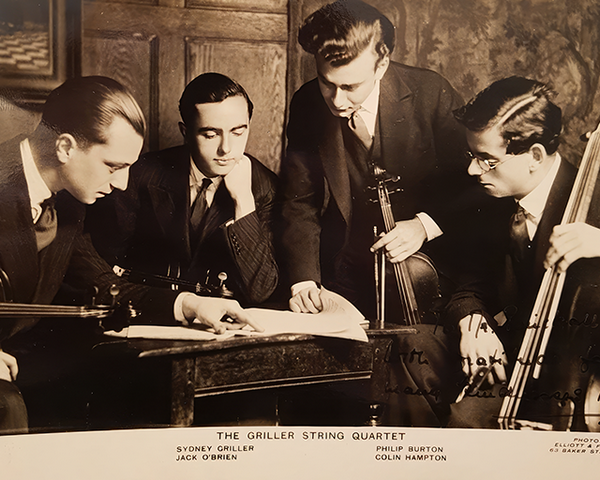
Griller String Quartet, 1938