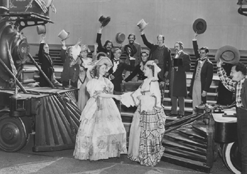
Cheering accompanies the completion of the Union Pacific Railroad, in Utah; from the original production.
Pageant on rail transport written for the 1939 World's Fair.
Book by Edward Hungerford; lyrics by various authors.
Cheering accompanies the completion of the Union Pacific Railroad, in Utah; from the original production.

A chronological narrative of the effect of railroads on American life, told through recreations of historical events (the first appearances of the Stourbridge Lion and Tom Thumb, the driving of the golden spike) and fictional scenes. The show was remarkable for the use of actual locomotives and Pullman cars, and for the complexity of the staging--actors lip-synched voices piped in from a special sound room below the stage, where the orchestra was also located. Because of its historical appeal and the novelty of seeing actual railroad cars on stage, Railroads on Parade was one of the most popular attractions at the Fair in 1939 and 1940.
1) Once Was the Time
2) Here's a Brave Beginning
3) Allegro moderato
4a) Alla marcia
4b) The British Grenadiers
5) Sostenuto -- allegro grazioso
6) Low Bridge
7a) Allegro assai
7b) Allegro assai
8a) Heave Away
8b) Allegretto moderato
9a) Allegro assai
9b) This Train Is Bound for Glory
10a) Westward Ho!
10b) Allegro giocoso
10c) Andante non troppo
11) I've Been Working on the Railroad
12) What the Engine Said
13a) Riding on the Railroad
13b) Alla marcia
14) Riding on the Cars
15a) Oh Mister, Where's the Train
15b) We're City Men of Sober Mien
15c) We're Travellers Through and Through
16) We Man the Trains
Additional material (1939 version, texts by Charles Alan):
17a) Our Lincoln Comes
17b) This Train is Bound for Glory
18a) Pullman Scene
18b) Wheels Through the Night
Additional material (1940 version):
19) The Sailor's Wife
20) Tell Ol' Bill
21) Snagtooth Sal/Sacramento
22) New Lincoln Scene
23) Two Little Girls in Blue
24) Pullman Blues
25) Orange Farm
Cast: Singing roles -- female narrator
(soprano), male narrator (tenor), numerous soloists from
chorus.
Speaking roles -- historic locomotives, historical figures,
financiers, businessmen, workers, travelers.
Orchestra: 1.1.3.(3 Sax).0; 0.3.2.1; Perc,
Gtr, Pno, novachord, Hammond organ; strings.
Duration: 70 minutes, 45 minutes music
Performance Rights and Rentals: All territories: EAMC
First Production: April 30, 1939, New York, World's Fair, Charles Alan, dir., Isaac van Grove, cond.
| Transcription Recordings | Radio broadcast of original cast, 1940 (contains over half of the show) |
See also the concert suite,
Trains Bound for Glory.
© 2012 The Kurt Weill Foundation for Music. All rights reserved.
Concert suite from
Railroads on Parade arranged by
David Drew
for tenor (baritone), SATB chorus, and orchestra.
Prelude: Sacramento (orchestra)
Sutter's Creek
Snagtooth Sal (tenor solo, chorus)
Tell Old Bill (baritone solo, men's chorus)
Rounding the Horn
The Sailor's Wife (chorus)
Old Gray Mare and The Iron Horse (orchestra)
Two Little Girls in Blue
Hurdy-Gurdy Waltz (orchestra)
Ballad, part 1 (tenor solo)
Cakewalk (orchestra)
Ballad, part 2 (tenor solo)
Souvenirs
Clementine (tenor solo, men's chorus)
Snagtooth Sal (orchestra)
Slow March (orchestra)
This Train Is Bound for Glory (chorus)
Orchestra: 1.1.2 alto sax (cl), tenor
sax, bari. sax; 0.3.2.1; 2 keyboards, strings.
Duration: ca. 20 minutes
Performance Materials: All territories:
EAMC
First performance: September 20, 1992, New York, American Symphony Orchestra, Leon Botstein, cond.
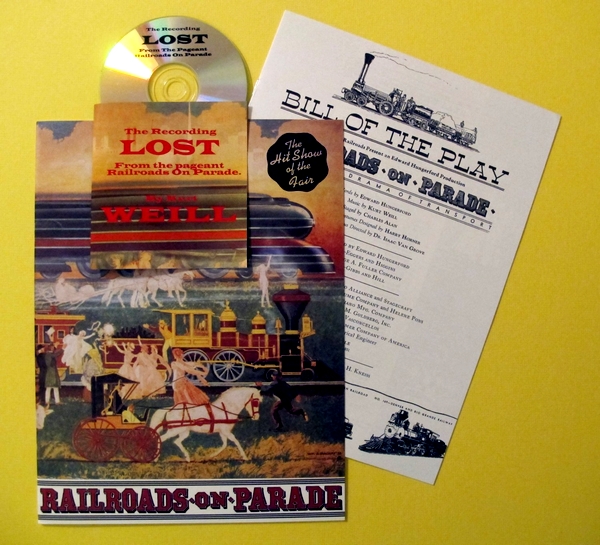
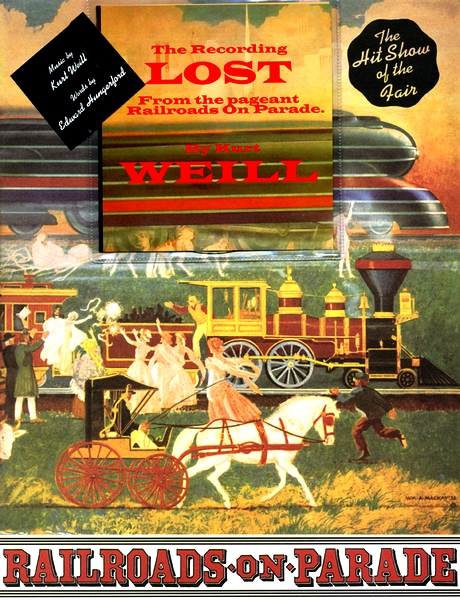 Newly available: a commercial recording of Weill's pageant for the
1939-40 World's Fair, Railroads on Parade. A nearly forgotten
work from Weill's American years, Railroads was a vast work
that featured real locomotives and train cars moving on and off the set.
The orchestra, singers, and actors worked in an enclosed room under the
stage, and the sound was broadcast into the amphitheater (the actors on
stage did not speak or sing). Approximately an hour long, the show ran
four times per day in the Fair's transportation pavilion; it was seen by
over two million people. But little trace survived, aside from
photographs and a few short silent film clips. Weill's manuscript score
is housed in the
Yale University Music Library, and a concert suite based on the
original score has been performed, but no sound recording of the World's
Fair performance was known to exist.
Newly available: a commercial recording of Weill's pageant for the
1939-40 World's Fair, Railroads on Parade. A nearly forgotten
work from Weill's American years, Railroads was a vast work
that featured real locomotives and train cars moving on and off the set.
The orchestra, singers, and actors worked in an enclosed room under the
stage, and the sound was broadcast into the amphitheater (the actors on
stage did not speak or sing). Approximately an hour long, the show ran
four times per day in the Fair's transportation pavilion; it was seen by
over two million people. But little trace survived, aside from
photographs and a few short silent film clips. Weill's manuscript score
is housed in the
Yale University Music Library, and a concert suite based on the
original score has been performed, but no sound recording of the World's
Fair performance was known to exist.
All that changed several years ago, when a set of four discs from a broadcast on the World's Fair radio station was discovered in New York by collector Guy Walker. The discs contain an abridged version of Railroads--almost 38 minutes in total. The original acetates are housed at the Archive of Recorded Sound at Stanford University, and the recording has been digitized and edited to produce the CD, now available from Transcription Recordings, Inc.
The deluxe packaging (above right) includes a complete facsimile of the original souvenir program and playbill from the Fair, with liner notes by Weill scholar bruce mcclung and audio restorer Aaron Z. Snyder. Railroad buffs, World's Fair fanciers, Weill fans, and students of Americana have an unprecedented opportunity to discover how Railroads on Parade sounded.
Features
Facebook page for Transcription Recordings
New York Times article on the recording
Stanford press release on purchase of original discs
Learn more about Railroads on Parade
Originally posted: 9 November 2012
Last updated: 12 December 2012
A Pageant-Drama of Transport
The 1930s were a dark decade for the U.S.
railroad industry. Increased competition from
the automobile reduced the railroad’s share of
the transportation market, and the economic
crisis of the Depression cut profits. Between
1929 and 1932 railroad income plummeted by $122
million, and the industry imposed a 10% cut in
wages that affected everyone from management to
railway
construction workers. President Roosevelt’s
“Hundred Days” of legislation in 1933 funded the
Public Works Administration and the building of
surface roads and bridges for the automobile
while the Emergency Railroad Transportation Act
increased government regulation and froze
railroad employment for three years. By the end
of the decade, one third of all railway lines
had filed for bankruptcy.
The railroad industry fought back with the
introduction of streamliners in 1934 and
promotional campaigns. With their art deco
styling, the streamliners glamorized rail travel
and attracted new customers with a promise of
unmatched luxury. Railroad promotion included a
series of lavish displays at the World’s Fairs,
which attracted millions of visitors. The New
York World’s Fair (1939/1940) saw the grandest
of these displays: twenty-nine Eastern railroads
banded together to purchase the Fair’s largest
site (17 acres) for a track display of 50
state-of-the-art railroad cars and engines; a
diorama of railroad construction (Building the
Railroad); a model railroad display (Railroads
at Work); and an outdoor pageant (Railroads on
Parade), which boasted a 4000-seat grandstand,
250-member company, and 20 steam locomotives.
Railroads on Parade had been the brainchild of
historian Edward Hungerford, the self-proclaimed
“foremost railfan of the country.” The pageant
merged Hungerford’s staff from his previous
pageants at the Great Lakes Exposition in
Cleveland (1936/1937) and Chicago World’s Fair
(1933/1934) with personnel from Weill’s Biblical
pageant, The Eternal Road (1937). Subtitled “A
Fantasia on Rail Transport,” Hungerford’s script
recounted the invention of the steam locomotive
(Prologue) and the opening of the Erie Canal (Act
I), surveyed early U.S. railroad history (Act
II) and historic events of the nineteenth
century (Act III), contrasted rail travel of the
1870s with the luxury streamliners of the day (Act
IV), extolled modern freight transport (Act V),
and imagined the railroad’s triumphant future (Epilogue).
Weill termed his original score a “circus opera”
and studded it with arrangements of folksongs
such as “Fifteen Years on the Erie Canal,” “I’ve
Been Workin’ on the Railroad,” and “Casey
Jones”; the spiritual “This Train Is Bound for
Glory”; and a newly composed song for the finale
entitled “Mile after Mile.” Because of the
massive scale of the outdoor stage, Weill’s
score had to be performed by an orchestra of 25
and a vocal ensemble of 17 below the stage, and
then piped up and amplified over the din of the
working locomotives. The chorus on stage
lip-synched, and actors pantomimed to amplified
voices, which also originated from the same
soundproof room as the orchestra and vocal
ensemble. With admission of twenty-five cents
and four performances a day, Railroads on Parade
proved to be one of the more popular exhibits of
the Fair: during the first season, it racked up
671 performances and a total attendance of
1,281,349.
For the 1940 edition of the Fair, Hungerford
reworked his script by cutting three scenes,
such as the extraneous one about the Erie Canal,
and adding four new ones, including one
depicting Lincoln’s funeral train making its
solemn return to Springfield, Illinois and
another set in a country rail station from the
1890s. Weill composed original music for these
passages such as a waltz and cakewalk, and
arranged the 1893 song “Two Little Girls of Blue”
for the Gay Nineties scene. He also composed a
lowdown number for the cut-away of a lounge car
of a new sleeper, which the Pullman Company
named Luxuryland for the production. Behind the
lounge car was a small compartment, and dancer
Betty Garrett did a slow striptease of
undressing to Weill’s “Pullman Blues.”
Despite its continued success with 1940
attendance figures near 1 million, Railroads on
Parade found itself out of step in a Fair that
promised “The World of Tomorrow.” Hungerford,
with his background as a railroad historian, had
set most of the scenes in the nineteenth century
and featured only steam locomotives. Diesel
engine production, however, had already
surpassed steam in 1938. As a result, General
Motors in its neighboring exhibit exhibited the
railroad of the future—an E-model
diesel-electric locomotive. GM’s Futurama, with
its modern towns and cities connected by a vast
network of highways, gave Fairgoers the promised
glimpse of the future and foretold the dominance
of the automobile in post-war America, whereas
Railroads on Parade, a historical pageant about
the past, portended the continued decline of the
railroad industry.
Until recently, most of what has been written
about Railroads on Parade has come from
playbills, souvenir programs, and newspaper
clippings and reviews. In 2008 four two-sided
acetate discs of Railroads on Parade were
discovered in a cardboard box in a New York
apartment. Recorded through a transcription
phonograph at the Fair, they had been intended
for an hour-long radio broadcast. Rather than
preserving either the 1939 or 1940 editions of
the pageant, the discs include scenes from both
editions and traverse the first two-thirds of
the pageant. With the digital restoration of
these discs by Aaron Z. Snyder, we are able for
the first time since 1940 to hear Edward
Hungerford and Kurt Weill’s Railroads on Parade:
A Pageant-Drama of Transport.
—bruce d. mcclung
bruce d. mcclung is a member of the musicology
faculty at the University of Cincinnati. His
first book, Lady in the Dark: Biography of a
Musical, won an ASCAP Deems Taylor Award. He is
currently writing a book about music at the
1939/1940 New York World’s Fair.
| Lancement | 19 octobre 2012 |
|---|---|
| Date de publication | Oct. 19th, 2012 |
| Maison de disques | Transcription Records, Inc. |
| Directeur général | Guy Walker |
| Lieu actuel | Hillsdale, NY |
| Contact presse | railroadsonparademusic@gmail.com |
|---|
BY CYNTHIA HAVEN
Composer Kurt Weill's Railroads on Parade was one of the most
popular attractions at the 1939-40 World's Fair in New York City. It has
never been performed since.
This shouldn't come as a surprise. The 70-minute pageant had a singing
cast of 250, with horses, cattle, Pullman cars and 12 real steam locomotives
onstage as part of the production. Not exactly the kind of show that can be
revived even by the most ambitious university repertory company.
There's only one known recording, and Stanford has it. The 16-inch LPs
are in the Stanford Archive of Recorded Sound, which celebrates its 50th
anniversary this academic year. The archive contains about 350,000 sound
recordings and 6,000 print and manuscript items, documenting all aspects of
20th- and 21st-century culture. It's one of the five largest sound archives
in the United States.
Open from 1 to 5 p.m. weekdays, the archive is secreted in a hard-to-find
corner in the basement of Braun Music Center. You know you've landed in a
different world when you see the archive's signature piece: a 1908 Aretino
phonograph, with a bright green horn, facing its dark twin, the black-horned
1906 Standard phonograph.
Both are nestled among a number of large, closed wooden boxes containing
mysteries of sound. A 4-foot-high 1890s treasure, with curved legs
supporting a mottled wood box with several keyholes, is a music box that has
five large interchangeable cylinders, each playing six tunes. Pull the hand
crank on the left, and the brass cylinder turns, with seven bells chiming an
additional layer to the tune. Another, smaller music box with an inlaid wood
lid featuring a music motif and tiny, hand-painted ivy leaves twining the
square of glass inside, plays Gounod, Sullivan and Verdi. The brass cylinder
is about 15 inches long—about the size of a roll of aluminum foil.
Gray cardboard boxes against the wall contain gifts from violinist Jascha
Heifetz (1901-87), including his never-released recordings. Others contain
the earliest tape recordings—of German vintage, circa 1930s. American
servicemen returned home with them and founded Ampex to duplicate the
technology.
The holdings "go back to the very earliest recordings, on cylinders,"
said Jerry McBride, head librarian for the Braun Music Library and the
archive.
The archive made waves nationally when it was the venue for last year's
premiere of the newly discovered "world's oldest recorded sound"—an 1860
phonoautograph recording of "Au Clair de la Lune."
Clearly, however, the archive is not just a place for music lovers: It
also includes broadcasts of Eleanor Roosevelt's radio program "Over Our
Coffee Cups"; in her clear, upper-crust inflections, she counsels American
women on the evening following the Pearl Harbor attack, saying, "Whatever is
asked of us I am sure we can accomplish it; we are the free and
unconquerable people of the United States of America." It holds the speeches
of Martin Luther King Jr. and Adolf Hitler.
Among the prizes is the Stanford Program for Recordings in Sound,
including readings of the "Stanford Poets," a group of poets who were
influenced, directly or indirectly, by the late Yvor Winters—an eminent
tribe that includes Thom Gunn, J. V. Cunningham, Donald Davies, Edgar Bowers
and others.
For many, however, the crown jewels of the collection are the recordings
for the Monterey Jazz Festival, the world's longest continuously running
jazz festival (it started in 1958—the same year as the archive). Featured
are some of the most significant jazz musicians of our time—Louis Armstrong,
Dave Brubeck, Velma Middleton, Billie Holiday, Paul Desmond and John Lewis.
The festival collection occupies more than 130 linear feet, including
1,400 sound recordings and 500 moving-image items. The project has attracted
major funding: The Grammy Foundation, the Save America's Treasures program
and the National Historical Publications and Records Commission, among
others,
have provided support. More than $350,000 in grant funds have been
awarded to digitize the fragile, aging and degrading media and to improve
storage of the festival recordings.
Shellac and vinyl discs, acetate and aluminum transcription discs, analog,
digital and audio cassettes—even Edison label wax cylinder recordings—are
all housed in the archive. It has, moreover, the rare equipment to play them:
crank-up gramophones, turntables, quarter-track and half-track tape players.
Stanford faculty have recommended some of the purchases. For example, the
landmark Weill find was recommended by Stephen Hinton, a professor of music
and senior associate dean for the humanities. Weill is the focus of Hinton's
research.
"He knew through the Kurt Weill Foundation that a collector had
discovered the recordings, and would we be interested?" recalls McBride, who
negotiated the purchase.
"The discs of Railroads on Parade were a real find," said Hinton.
"Many still pictures and even some movie footage have survived of the
pageant, but until now we have had no sound to go with them. The discs
Stanford acquired appear to be the only ones available and fill an important
gap in our knowledge of
Weill's career, particularly of his use of folk song."
Moreover, Railroads on Parade has a special connection to Stanford:
A highpoint of what Weill termed his "circus opera" includes the character
of university founder Leland Stanford, former governor of California and
president of the Central Pacific Railroad, as he pounds the "golden spike"
that completed
the first transcontinental railroad in Promontory Summit,
Utah, on May 10, 1869. Although Stanford's first swing of the silver maul
missed its target, word flashed immediately around the nation by telegraph—in
that sense, it was one of the first nationwide media events.
"It seems only appropriate that one of the principal documents of a work
that includes mention of Leland Stanford as a pioneer and dreamer be housed
here at his own university," Hinton said.
A few minutes of Railroads on Parade can be seen on YouTube. But
to hear it, go to the Stanford Archive of Recorded Sound.