
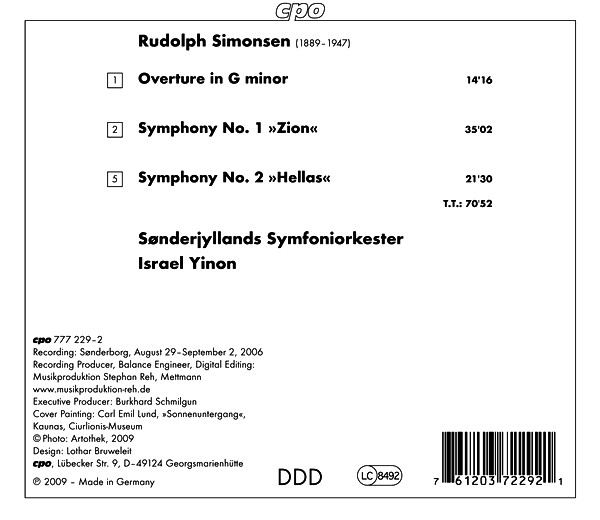
 Rudolph Simonsen
Rudolph Hermann Simonsen (April 30, 1889 - March 28, 1947) was a Danish composer who studied under Otto Malling.
http://www.youtube.com/watch?v=ekkkPkhY4cY
Symphony No. 1 in C minor, "Zion" (1910)
I. Kampf Gegen Knechtschaft (Fight Against Slavery)
II. Verheissung (Promise)
III. Allegro Con Brio
In 1928, he won a bronze medal in the art competitions of the Olympic Games
for his Symphony No. 2: Hellas.
"Simonsen was an important figure on the Danish musical scene and lived until
1947. He was a disciple of Carl Nielsen and took over that composer's position
as principal of the Royal Danish Academy of Music in 1931 when Nielsen died. He
had been teaching music history and piano since 1915 and had a mission to
promote classical music to as many people as possible. He also worked to bring
new foreign music to Denmark, and make strong links with Germany, Austria and
Hungary."
"Coming from a Jewish middle class family in Copenhagen, Simonsen was a prodigy,
and not just in music. He had a fluent command of Greek, Latin and Hebrew, and
he wrote philosophical treatises on Plato, Spinoza and Goethe. In his later life
Simonsen concentrated on music teaching and performance and most of his
compositions come from the 1920s, early in his career. He created three
symphonies as a grand cycle, based on the cornerstones of classical culture:
Jewish, Greek and Roman. (Thus No. 1's "Zion" refers not to The Matrix films but
to Jewish culture, and "Hellas" to the Greek.) The themes of Zion concern the
wandering of the Jewish people from slavery to the Promised Land, though it is
not actually a programmatic work. This was the first time a Danish composer
wrote a work directly referring to Jewish culture. The 35-minute work is
intense, enthusiastic, and quite original."
http://www.youtube.com/watch?v=XKQ3LWsKCCs
Symphony No. 2, "Hellas" (1910)
I. The Oresteia
II. Loneliness at the Temples
III. The Goddess of Victory Pallas Athena
Symphony No. 2 is shorter and seems more influenced by Nielsen. It uses advanced counterpoint in the service of dramatic expression. Its three movements deal with three ancient Greek subjects: the first Aeschylus' trilogy The Oresteia, the second paints an austere mood on the Acropolis for Loneliness at the Temples, and the last movement is titled The Goddess of Victory Pallas Athena. This symphony sounds even more original, and makes one sorry that Simonsen's works received so little attention during his lifetime. He narrowly missed having his First Symphony premiered by Toscanini, which would have done much for his reputation.