
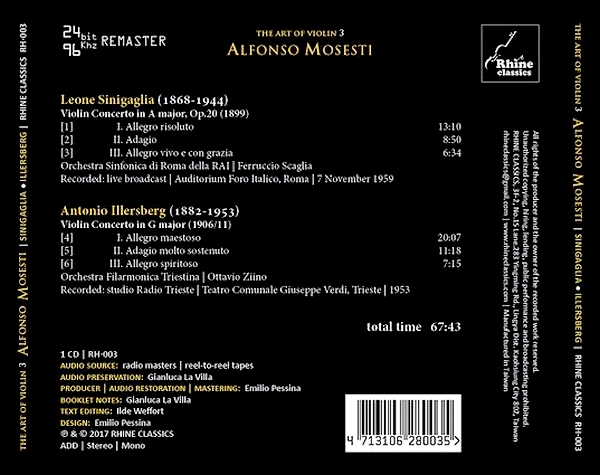
 The Art of Violin 3
Subtitled ‘The Golden Age of Concertmasters’, this interesting release focuses on the Italian violinist
Alfonso Mosesti (b.1924).
He studied with Cesare Barison and Antonio Illersberg in Trieste.
From 1954-1999 he was concertmaster of the RAI Orchestra in Rome.
One of his claims to fame was his premiering of the rediscovered Gaetano Pugnani Violin Concerto in D major, as well as giving the first performance of the Antonio Illerberg Concerto featured here.
Leone Sinigaglia studied at the Conservatory in Turin with Giovanni Bolzoni. Throughout his career he associated with Brahms and later worked in Prague with Dvořák. As a Jew he was persecuted by the Nazis during the War, tragic events which no doubt contributed to his death from a fatal heart attack in 1944. He was a mountaineer of some renown, achieving some notable ascents in the Dolomites. His Violin Concerto was completed in 1899 and dedicated to his friend, the violinist Arrigo Serato a former pupil of Joachim. Serato premiered it in Berlin in November 1901. In the traditional three-movement mould, the first opens with an almost militaristic theme, and the ‘risoluto’ marking at its head pervades the movement. Energy and drama underpin the narrative, but there are moments of impassioned lyricism, too. The solo part is demanding by any standards, and Mosesti steps up to the mark admirably. He possesses immaculate intonation and a flexible vibrato, enabling him to colour his playing with an extensive range of tonal shadings. A horn passage heralds in a fetching Adagio. Sinigaglia demonstrates a natural flair for melody, and this is one of the most attractive concerto movements I’ve ever heard. Mosesti brings warmth and eloquence to his reading, and the application of some tasteful portamenti adds to the allure. The finale is nicely articulated with some crisply incisive spiccato bowing. The general mood is genial and spirited. This live broadcast is conducted by Ferruccio Scaglia, who proves a sensitive collaborator, alert to the ebb and flow of the narrative of this deliciously attractive score.
Antonio Illersberg was orphaned from an early age and taken into care. He showed musical promise from the start, mastering an array of instruments. He studied at the Liceo Musicale of Bologna with Luigi Torchi and Giuseppe Martucci. A fellow student at the time was Ottorino Respighi. He later taught at the Verdi Conservatory in Trieste. Luigi Dallapiccola was one of his students. His Violin Concerto had a lengthy gestation from 1906-1911, and he dedicated it to Cesare Barison. It was premiered in 1951, by Mosesti. The recording here was made two years later in 1953. Cast in three movements, it conforms to the fast-slow-fast pattern. The opening movement hints at what is to come – a late Romantic canvas, colourfully scored with long spun melodies. It doesn’t quite have the technical difficulties of the Sinigaglia, yet the soloist is put through his paces. The highlight for me is the exquisite Adagio, with its Mahlerian harmonic flavours. Wistful and nostalgic, Mosesti caresses the phrases with ardent feeling and tenderness. A sparkling and fiery finale caps off proceedings, which the violinist dispatches with vim and vigour. Ottavio Ziino and the Orchestra Filarmonica Triestina offer sterling support.
The recordings have scrubbed up well for their age and provenance thanks to the
expert remastering of Emilio Pessina. The documentation is second-to-none,
written by Gianluca La Villa, who sets the music in some sort of historical
context. Also included is an interview the violinist gave to Nicola Gallino in
2007 in which he discusses some of the famous names he has encountered
throughout his distinguished career. The beautifully reproduced black and white
photographs are the icing on the cake.
The value of this release lies in the rarity of these captivating scores,
performed by a violinist with a close affinity to both.
Stephen Greenbank
Despite the rarity of the repertoire, Rhine Classics has promoted its latest release under the name of the soloist in both works, Alfonso Mosesti, in its ‘The Golden Age of Concertmasters’ marque.
There’s a pleasing interview in the booklet reproduced from La Repubblica in which Mosesti reflects about his experiences as a performer and comments on the conductors with whom he performed during his distinguished career as a leader in Italian orchestras.
There’s also a charming photograph of Mosesti and David Oistrakh taken in Turin. Mosesti, born in 1924, was a pupil of Antonio Illersberg and Cesare Barison in Trieste and performed as soloist and concertmaster in Naples and Turin from 1954 to 1999.
I last listened to the Illersberg Concerto in the context of a DVD (see review).
As I wrote there, it was written between 1906-11 and was dedicated to Mosesti’s teacher, Barison.
For some reason, the work remained unperformed until its belated premiere in 1951 by Mosesti, two years before the composer’s death. The full score and parts are now missing so what is performed is the only
authentic example of the concerto, the recent filmed performance being a reconstruction by the conductor Adriano Martinolli D’Arcy based on the violin and piano reduction and details heard in this live 1953 RAI broadcast of the
work’s second performance.
It’s a classically conceived piece in three movements opening with some virtuoso flourishes for the soloist and plenty of vigorous late-Romantic swagger and sensitivity.
Illersberg writes attractive melodies and his wind writing is
especially felicitous and this contributes to the tremendous drive and energy of
the first movement. There’s a lied-like quality to the slow movement where some
lightly drawn Mahlerian influence can perhaps be felt.
The flighty finale, full
of verve and renewed rich orchestral palette shows some kinship with his
erstwhile fellow student, Respighi. Much of the solo sound world is orientated
to the violin’s upper strings which vests a bright, silvery almost aquiline
patina. Mosesti plays with unfailingly fine tone and has the sensitivity to play
quietly in the lovely slow movement. This is deft, sensitive, stylish playing
and it’s fully equal to the expressive demands of the music, as much as to the
technical ones. Ottavio Ziino directs the Trieste Philharmonic very capably.
Sinigaglia is a better-known figure than the rather more obscure Illersberg. His
1899 Concerto was dedicated to an earlier master of the Italian violin school,
Arrigo Serato, who premiered it in Berlin two years later and took it to Vienna
(where Nikisch conducted) and to his homeland in Milan in April 1902 where
Toscanini was on the rostrum. It too is in a well-established three-movement
format. Ferruccio Scaglia sculpts the opening paragraphs with confident, even
aggressive direction and Mosesti responds with the most varied and felicitous of
bowing, negotiating the writing with great elegance. His control of tone colour
and bow pressure is admirable, and when he tightens the vibrato his tone never
turns metallic. It’s a far more soft-grained tonal arsenal than commonly to be
heard from the Russian school and reflects Mosesti’s Italianate training and
heritage perfectly.
The Sinigaglia should be far better known than it is. It has something of the
open-hearted quality of the Dvořák, the freshness of the Goldmark and a full
quotient of ripe lyricism cut from high late-Romanticism. The central movement
is a meditative Arcadia, established by the horns and winds, topped by the
violin’s songful lyricism, whilst the finale is avuncular, hinting at an axis of
Dvořák-Brahms. As the recording is quite close-up the listener can catch many
examples of Mosesti’s subtle and supple bowing.
The restoration by Emilio Pessina is excellent. The authoritative booklet has
been written by Gianluca La Villa and provides a wealth of important
information. You will also find the quality of photographic reproduction to be
at a very high level.
This brace of Italian concertos preserves much that is lyric and generous-minded.
If you have an affinity with the composers cited in the review and are not
allergic to historic recordings, then you will enjoy exploring these
barely-heard scores, and find much pleasure in doing so.
Jonathan Woolf