|
Erich Wolfgang Korngold (1897–1957)
Much Ado About Nothing • Der Vampir
If there’s one thing that’s particularly distinctive about Korngold
as a composer, it’s his extremely close and above all multifaceted
relationship with theatre in all its forms. His very first work to
receive a public performance was a ballet pantomime entitled Der
Schneemann (‘The Snowman’); he achieved his greatest
successes with operas like Die tote Stadt (‘The
Dead City’); and he went down in the history of music as the composer of
numerous film scores whose influence can still be felt in Hollywood
style to this day. His two early sets of incidental music can be seen as
a kind of prequel to these film commissions. Of the two, the music for
Shakespeare’s Much Ado About Nothing is
the better-known and more extensive.
Korngold wrote the Shakespeare incidental music for a production at
the Palace of Schönbrunn in Vienna that premiered on 20 May 1920.
Because of the cramped conditions, Korngold only had a fairly limited
number of musicians at his disposal, hence the relatively small chamber
forces when he would have probably preferred to write for full
orchestra, as you can hear from the music. The production was
exceptionally well received and a great success for the composer, who
was still pretty young, though it was soon to be eclipsed by his opera Die tote
Stadt, which was premiered soon after. Soon after the production,
Korngold published an orchestral suite of several pieces from the
incidental music. This has since been among his more popular works. For
a long time the rest of the music lay unperformed, something which has
only recently changed.
When composing his incidental music, Korngold could draw on a long
tradition represented during the Classical and Romantic periods by
composers like Beethoven (Egmont, Coriolan) and Mendelssohn (A Midsummer
Night’s Dream). The function of these Classical sets of incidental
music was not so much to illustrate the play directly (as became the
case with film) as to fill in the gaps. Typically, incidental music
comprises interludes to be played between the acts, framed by a longish
overture and a short finale presenting the basic mood of the play and
sometimes also important elements of the plot. In addition, some plays
require music to be played on stage or contain songs, which naturally
require a setting. Shakespeare’s plays are particularly good at offering
such opportunities.
In a number of places, Korngold goes a major step further; some of
the music numbers are not just played between scenes but instead
accompany the dialogue as a melodrama or a characterising interjection.
This already anticipates his later technique when composing film scores,
which is based on drama and music coinciding. The music sometimes also
has a dramatic function – dance music, for example – but it goes far
beyond that by taking the mood of a given dialogue or elements of its
subject-matter and giving them a musical representation.
Much Ado About Nothing is one of Shakespeare’s
socalled minor comedies, which were still very much in line with
contemporary taste. But it has qualities of its own, among them the
pronounced wordplay associated particularly with the reluctant lovers
Beatrice and Benedick. In Dogberry and Verges, two stalwart but not
particularly bright constables, Shakespeare created two of the funniest
characters in his plays. But there are tragic and tragically inclined
elements as well, centred above all on the character of Hero. Although
things turn out well here, the slander of her and her subsequent
rehabilitation thanks to the ruse of pretending she has died could also
serve as elements of a tragic plot (cf. Romeo and
Juliet, for example). This strand of the action in particular helps
to add a breadth and depth to the emotional states presented in the play
that other typical comedies of the period rarely achieve.
As befits good incidental music, Korngold’s individual pieces are
very sensitive to the relevant mood or frame of mind. He starts with the
comic, amusing and humorous – at least that’s how the Overture begins.
Its lively, nimble rhythms are clearly reminiscent of the Italian
tradition and composers like Rossini. The second subject of the Overture,
which is in sonata form, is then a definite love theme providing
emotional warmth without descending into sentimentality. The element of
danger and malicious intrigue is also represented, if only in passing in
the twists and turns of the development section, but the upbeat themes
soon regain the upper hand.
Among the other pieces there are some that have a direct dramatic and
descriptive role. The short, martial Kriegsmusik (‘Battle
Music’), for example, marks the entry of the main characters returning
home from the war. The Don Juan motif
serves to depict this figure’s darkness of character. The Marsch
der Wache (‘March of the Constables’) not only
accompanies Dogberry, Verges and the rest of the Watch when they come
marching in, its grotesquely overdrawn march rhythm also very aptly
depicts them in all their involuntary comedy and comic earnestness. The Intermezzo accompanies
two love scenes and is one of the most beautiful and expressive but
simple pieces in the entire work. A wonderfully tender cello cantilena
rises above a simple piano accompaniment, then gradually other voices
enter, so that the whole thing opens out into a multi-voiced love song.
A solemn Kirchenszene (‘Church Scene’)
in the manner of a chorale accompanies the first marriage ceremony,
which is thwarted by Don Juan’s machinations. Finally, the Trauermusik (‘Funeral
Music’) expresses Claudio’s grief and despair when he believes the woman
he loves is dead.
The lengthy Festmusik (‘Festive
Music’) is an outlier. It is essentially an extended waltz that
accompanies the scenes that take place during the masked ball in Act II.
Its open form, with its many interruptions, is related to the fact that
this music is added to the scene’s dialogue and therefore takes account
of it. The music is thus both part of the stage action (the
realistic-sounding dance music) and a commentary on the stage action and
the dialogue. The pretty Lied des Balthasar (‘Balthasar’s
Song’), which Shakespeare had always envisaged as a musical element,
also forms part of this scene. Korngold’s setting of the poem is
relatively simple but extremely moving; a subtle vein of historicism is
discernible, as though he wanted to consciously hark back to
Shakespearean tradition.
By comparison, the interludes are rather more detached from the stage
action. They comment more, summarising the state of the characters’
emotions and preparing what follows. So the prelude to Act II, the Mummenschanz (‘Masked
Ball’), anticipates the masked ball and is correspondingly dancelike and
lively. The exquisite Gartenmusik (‘Garden
Music’) that forms the prelude to Act III is a real gem. In the outer
sections Korngold conjures up a vision of an absolute paradise of a
garden, using a positively Impressionistic arabesque figuration. Then
the main section is again a kind of love song, rather similar in style
to the second subject of the Overture, but still
more deeply felt and broadly sung. The mood is suddenly fractured by a
central section that probably hints at Don Juan’s sinister machinations
and the dramatic action to come, then the love theme resumes. The
prelude to Act IV, Mädchen im Brautgemach (‘Maiden
in Her Bridal Chamber’), is a sensitive portrayal of Hero’s ambivalent,
half expectant, half nervous mood before the wedding. The chambermaids’
teasing is there as well. The Schlusstanz (‘Final
Dance’) is a slight variation on the Mummenschanz,
ending the incidental music in buoyant, cheerful vein.
While the music for Much Ado About Nothing enters
into a dialogue with the play and is able to stand as an equal partner
to the stage action, the ‘discreet incidental music’ to Hans Müller-Einigen’s
play Der Vampir oder Die Gejagten (‘The
Vampire, or: The Hunted’) is a long way from this approach. Here the
music accompanies the dialogue and stage action throughout, as it would
in a film (and not just in a few places as in Much Ado
About Nothing) – though Korngold does give
very precise directions as to how the two levels should be coordinated.
The music thus directly underscores and comments on the action and is ‘discreet’
insofar as it does not demand any space in its own right. This means it
offers an immediate response to the action; it isn’t reflective, it
elucidates, underlines and characterises directly – just as film music
later would. The music and the drama are so closely linked that a
concert performance without any knowledge of the play doesn’t really
make sense. Our concert version tries to remedy this by using a narrator
to give at least some idea of the plot.
The plot is a mix of Künstlerdrama (a
German dramatic genre dealing with the problematic nature of being a
creative artist), psychological study and surreal, grotesque tale. It
centres on a sculptor with far more ambition than talent and his
desperate attempts to achieve fame by winning a prize that has been
advertised. The supporting characters are a pious girl who is in love
with him, an extremely talented brother, an influential Swiss
industrialist and his wife, who is disillusioned with life. Between
these characters a thoroughly complex web of relationships and equally
complex storyline develop. The interplay of desire, seduction, ambition
and greed is encouraged by the so-called ‘manikin’ – the vampire of the
title. As an unreal figure who only really exists in the characters’
subconscious, he embodies their secret desires and repressed,
unacknowledged cravings, which he both brings out into the open and
reinforces.
It is no wonder that it is this character that fires Korngold’s
imagination. The manikin’s motif permeates the entire work, illustrating
the constant presence not just of the character, but the greed he
represents, which is shared by all the characters. The infatuated girl
Marie’s theme offers the only effective contrast; its simple
melodiousness is as unlike the manikin’s grotesque music as could be.
Alongside it there are a few slightly distorted dance movements (waltzes
and foxtrots) that serve partly as background music, partly as an
expression of the grotesque, and a fairly lengthy, thoroughly surreal,
completed dream sequence with a Greek-style chorus.
While this dream sequence does constitute one of the climaxes of the
play, it does not come anywhere near the end. But it is the last piece
in the incidental music. It looks as if Korngold only wrote music for
about half the play. No music for the missing two and a half acts has
survived, at any rate. Korngold scholars disagree about to how to
explain this state of affairs. Some thought that Korngold broke off work
on Der Vampir before he’d finished,
in order to focus on other projects. To support this theory, they
suggested that Korngold only wrote the incidental music for Müller-Einigen’s
play to make up for him not having been allowed to write the libretto
for his operatic hit Die tote Stadt, despite
having originally been invited to do so. In the meantime, the prompt
book for the premiere of Der Vampir has
turned up, however, and that has music entries noted for Acts IV and V.
We now therefore assume that there was more music, but that the score
either went missing or was destroyed in the confusion of the Second
World War. Or that it is slumbering somewhere or other, waiting to be
unearthed. So it could well be that more music turns up at some stage,
in the same way as the music we’re playing now was only discovered a
matter of years ago and published in 2010. Should this be the case, the
Holst-Sinfonietta will, of course, be available.
Cornelius Bauer
English translation: Susan Baxter
|
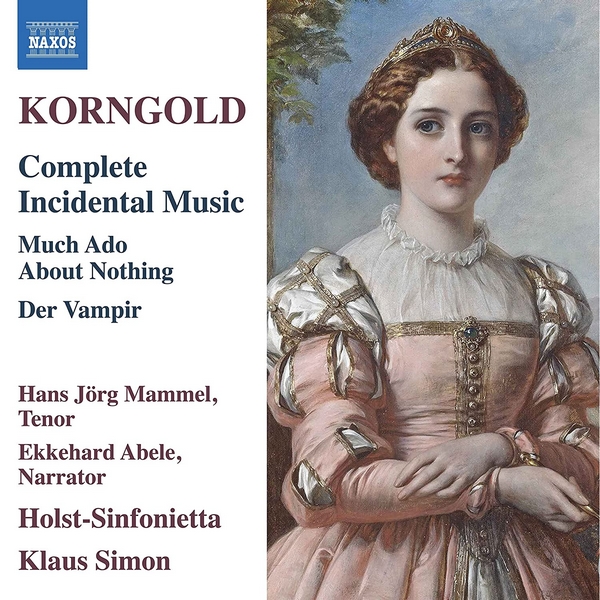
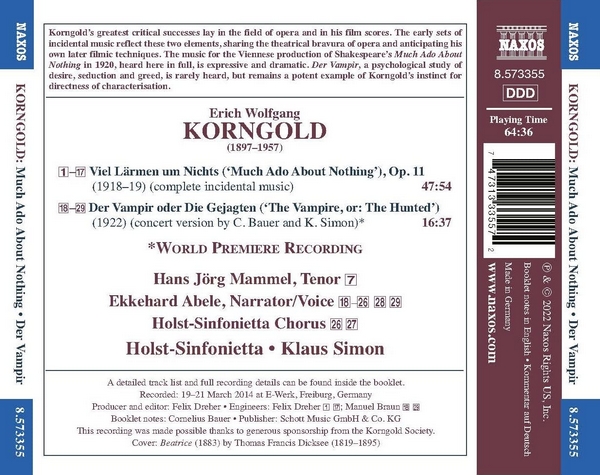 Erich Wolfgang Korngold : Complete Incidental Music