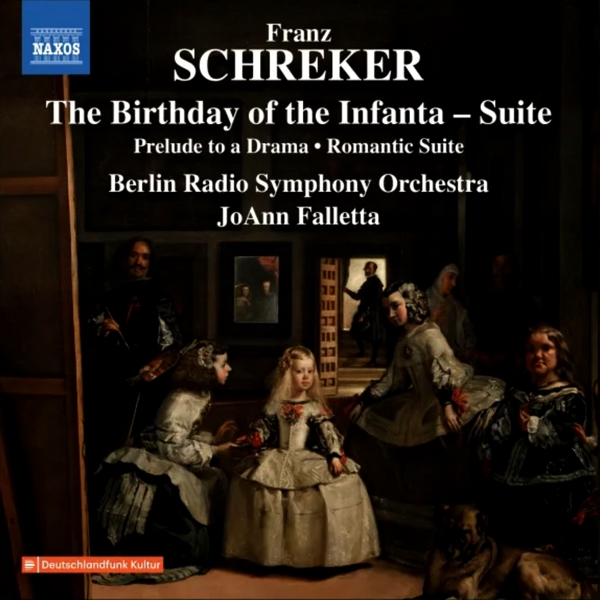
 Franz Schreker
Naxos 8.573821
Rundfunk-Sinfonieorchester Berlin
JoAnn Falletta
14 septembre 2018
- Der Geburtstag der Infantin Suite
- Vorspiel zu einem Drama
- Romantische Suite
In the JoAnn Falletta records Franz Schreker’s musicJune 28, 2017 by JoAnn Falletta
Thanks to Naxos, I was able to make my first visit to Berlin, enjoying a beautiful week in June in this fascinating city. Most of the time was spent in the warm and resonant acoustics of the historic hall of the Berlin Radio Symphony.
The orchestra and I were recording works by the extraordinary Franz Schreker, whose music flourished in Austria in the first decades of the 20th century, but whose career was irreparably damaged by the political anti-Semitism of the 1930’s.
Schreker went from being the second-most performed living composer (after Richard Strauss) to almost complete oblivion. Acclaimed as the great hope for German opera, he became “irrelevant” and died young, his career destroyed.
JoAnn Falletta with BRO’s mandolin and guitar Naxos is helping to create a renaissance for Franz Schreker’s highly individual voice, which is a complex mixture of romanticism, impressionism, expressionism, extended tonality and symbolism.
The Berlin Radio Symphony played the music with great depth and colour, and a special empathy for this incredible artist.
We recorded his Prelude to a Drama, an expanded independent version of the prelude to his greatest opera,
Die Gezeichneten (Those marked by the seal) of 1913–1915.
It is a profoundly beautiful work of musical art with ecstatically passionate melodies, gorgeous harmonies, magnificent orchestration, and an aesthetic unity that challenges even the best scores of Richard Strauss.
Shimmering with orchestra colours and voluptuous sensuality, this glorious work deserves to be played by orchestras all over the world.
Schreker’s Romantic Suite is a relatively early work, displaying the composer’s youthful optimism and confidence in music that is cohesive, compelling,
and filled with a kind of noble grandeur. A slow Intermezzo for strings adds a perhaps prescient melancholy that is truly unforgettable.My particular favourite is his
The Birthday of the Infanta-Suite, a pantomime based on Oscar Wilde’s novel of the same name.
The tale of the dwarf, who falls in love with the Infanta Margarita Teresa and dies of a broken heart when she cruelly taunts him, inspired Schreker to a breathtaking tenderness.
The score (complete with guitar and mandolin) recreates the 17th-century world of the famous Las Meninas of Velázquez.
Schreker’s sympathy for the abused dwarf possibly reflects his own suffering due to the homophobia and anti-Semitism to which he was brutally subjected.
The Berlin Radio Symphony Orchestra was superb—passionately committed to this
music and to the Naxos recording. Tonmeister Wolfram Nehls and his team were great artistic partners and created an environment of musical excellence and support.
I want to express a special thank-you to Johannes Kernmayer for his artistic guidance, and of course to Klaus Heymann for his vision and imagination.
Joann Falletta