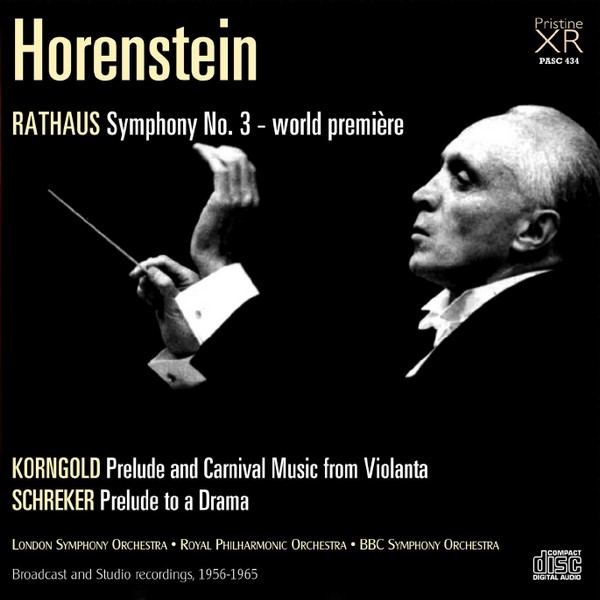
 Jascha Horenstein conducts Rathaus, Korngold and Schreker
Pristine Classical PASC434
Recorded 1956-65
Musical Notes by Misha Horenstein
71:50
- Karol Rathaus : Symphony No. 3, Op. 50 (1942-43)
London Symphony Orchestra
BBC Farringdon Studios, London, 13 March 1956
World première performance and recording - Franz Schreker : Prelude to a Drama (1913)
BBC Symphony Orchestra
BBC Maida Vale Studio 1, London, 16 November 1957
BBC Third Programme, 8pm broadcast - Erich Wolfgang Korngold : Prelude and Carnival Music from Violanta (1914)
Royal Philharmonic Orchestra
Kingsway Hall, London, 2 June 1965
Released with kind permission of the Royal Philharmonic Orchestra
- Karol Rathaus : Symphony no. 3, op.50 (1942-43), London SO, 13 March 1956 (recorded at BBC Farringdon studios), world premiere performance and recording
Karol Rathaus was one of Horenstein's oldest and closest friends.
The major work is the world première performance - and recording - of Rathaus's Symphony No. 3, made by the BBC in 1956, a couple of years after the composer's death and some 13 years after it was written.
Karol Rathaus was one of the most interesting composers of the exile generation. His musical language has its roots in the post-Romanticism of the early 20th century and in the early works of Schoenberg.
During the 1920s, the period of his greatest successes, he was considered very radical and "inclined to atonality" but today his style can best be described as neo-Romantic, a fusion of the emotional surge of the nineteenth century with the vigor, motion and rhythmic vitality of the twentieth.
Despite his rich use of chromaticism and dissonance, Rathaus's musical world was essentially harmonic and tonal. His great skill as an orchestrator and his outstanding sense of rhythm endow his music with unusual vibrancy and vitality, in a manner that is scintillating, transparent, and idiomatic. He is also capable of evoking and sustaining a haunting, introspective lyricism that makes many of his slow movements memorable. It was his ability to fuse "tradition and evolution" that so impressed some of Berlin's most perceptive critics, who hailed him as "one of the strongest hopes of our new music."
After his move to America Rathaus's harmonic language became leaner, bolder, more acrid and dissonant, with an occasional digression into the grotesque and satirical as an escape from sentiment, elements that aptly characterize the mood of his Third Symphony.
Karol Rathaus was one of Horenstein's oldest and closest friends. A fellow student of Schreker's, they grew up and studied together in Vienna and then in Berlin, both their careers developed simultaneously and rapidly, both survived the Nazi period in exile in France and in America and both men saw a dramatic downturn in their fortunes after the war. But while Horenstein was eventually able to resurrect his career, Rathaus, whose music was so admired during the Weimar period, was excommunicated, cold-shouldered by the post-war realignment of musical priorities that cast him out of consideration and from where he has still not fully emerged. He died in 1954 at the age of only fifty-nine, a respected and honored professor of music at Queens College in New York but dispirited, disappointed and totally neglected as a composer.
Throughout his career Horenstein made enormous efforts to perform Rathaus's music and succeeded on a number of occasions, giving premieres of his works in France, Germany, Israel, Switzerland, Mexico and other Latin American countries as well as in Britain, where the present recording was made. As far as is known, this version of the Third Symphony, recorded in a BBC studio with no audience present, was the first performance of the work and Horenstein considered it a posthumous tribute to his recently departed friend. He conducted the symphony again before an audience in Berlin two years later, but whether that occasion constituted the work's first public performance is unknown. - Franz Schreker : Prelude to a Drama, BBCSO, 16 Nov. 1957 (Maida Vale Studio recording)
Horenstein studied composition with Franz Schreker, first as a private student then later in his class at the Hochschule in Berlin.
The Schreker, like the Rathaus, is a BBC recording, this time for a live concert broadcast. Neither the Rathaus nor the Schreker has been released before.
Contrary to what is generally assumed, Franz Schreker was not Horenstein's composition teacher at the Academy of Music in Vienna. He did study with him as a private student but only later joined his class after Schreker moved to the Hochschule in Berlin in 1920. Schreker was not enamoured of Horenstein's skills as a composer but very quickly recognized his true talent, procuring for him his first conducting job while still a student, in charge of two choirs directed until then by Hermann Scherchen. He also had a say in some of Horenstein's other appointments, but his influence and popularity as a composer took a dramatic plunge just as Horenstein's conducting career was beginning to take wing and although he made several attempts to perform his old professor's music during this period, none were successful before the arrival of the Nazis put a stop to everything. After the war there were several occasions when Horenstein programmed Schreker's music but it was not until 1952 and then 1957, the date of the present recording, that he was successful. Both events featured "Prelude to a Drama" and are the only known occasions that he conducted any music by Schreker. - Erich Wolfgang Korngold : Prelude and Carnival Music from Violanta, RPO, June 2, 1965 (at Kingsway Hall), London
Erich Wolfgang Korngold was one of Horenstein’s fellow students at the Academy of Music in Vienna.
The Korngold was recorded as an extra during sessions with the RPO in 1965 for Reader's Digest and was produced by the composer's son.Erich Walter Korngold was one of Horenstein’s fellow students at the Academy of Music in Vienna. In April 1916 Korngold’s one-act tragic opera "Violanta" received its local premiere at the Burgtheater conducted by Bruno Walter. Recalling the event many years later Horenstein told an interviewer that he and his Academy friends, probably jealous of Korngold's wunderkind status, went to the premiere intending to boo and make trouble but instead were so captivated by the opera that at the end they carried Korngold through the streets on their shoulders like a hero. This is the only known contact between Horenstein and Korngold during the Weimar period, although they did meet socially after the war in California. The "Prelude and Carnival Music" from "Violanta" was recorded by Charles Gerhardt and produced by George Korngold, the composer's son, for Reader's Digest Recordings. The recording was unplanned, an afterthought following the early completion of Rachmaninoff's "Isle of the Dead", and was never published on the Reader's Digest label although it has appeared in various pirate editions. It was the only time Horenstein conducted Korngold's music, although in 1969 plans were made by the BBC for a complete recording of "Violanta" that, much to his distress, had to be shelved because of budgetary constraints.
Producer's Note
These three rare recordings offer a fascinating insight into Horenstein's musical friends and contemporaries: each composer, in his own way, was close to the conductor's heart. The main item, Rathaus's Symphony No. 3, was receiving its world première in an audience-free BBC studio, some 13 years after it was completed, and two years after the composer's death. The Schreker was another BBC recording, this time from a live concert at Maida Vale. Finally, the Korngold was recorded in stereo by Decca engineer Kenneth Wilkinson and produced by the composer's son, George Korngold, during spare time following a 1965 Reader's Digest session with the Royal Philharmonic.There is considerable variation in sound quality: the 1965 stereo Korngold is by far the best, and we're grateful to the RPO for permission to release it here in light of considerable confusion over copyright ownership. The other two works were transcribed at some point from disc sources unknown; the Rathaus is the better of the two, with a wider tonal and dynamic range, while the top end is somewhat limited on the Schreker, though both have enormously improved by XR remastering over the thin and shrill source material with which I began.
Andrew Rose