
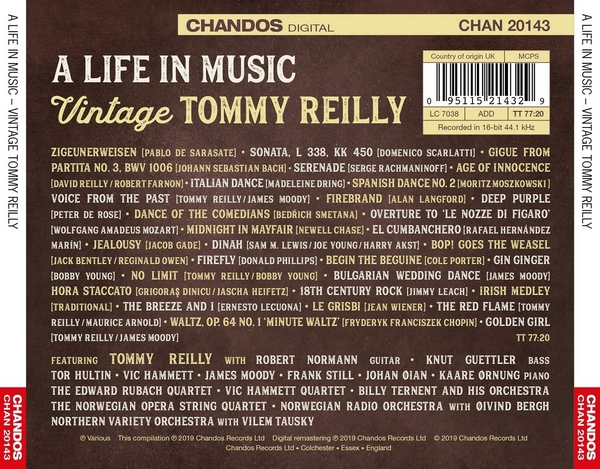
 Life in Music
Vintage TOMMY REILLY
Chandos CHAN 20143
71 minutes
23 août 2019
1. Zigeunerweisen - Tommy Reilly; Norwegian Radio Orchestra; Oivind Bergh
2. Sonata - Tommy Reilly; Kaare Ornung
3. Gigue from Partita No.3 - Reilly, Tommy
4. Serenade - Tommy Reilly; Kaare Ornung
5. Age of Innocence - Tommy Reilly; The Norwegian Opera String Quartet
6. Italian Dance - Tommy Reilly; Kaare Ornung
7. Spanish Dance No.2 - Tommy Reilly; Kaare Ornung
8. Voice from the Past - Tommy Reilly; The Norwegian Opera String Quartet
9. Firebrand - Tommy Reilly; Kaare Ornung
10. Deep Purple - Tommy Reilly; Frank Still
11. Dance of the Comedians - Tommy Reilly; Billy Ternent and his Orchestra;
12. Marriage of Figaro Overture - Tommy Reilly; Billy Ternent and his Orchestra;
13. Midnight in Mayfair - Tommy Reilly; Vic Hammett
14. El Cumbanchero - Tommy Reilly; Vic Hammett Quartet;
15. Jealousy - Tommy Reilly; Vic Hammett Quartet;
16. Dinah - Reilly, Tommy
17. Bop! Goes the Waesel - Reilly, Tommy
18. Firefly - Tommy Reilly; Northern Variety Orchestra; Vilem Tausky
19. Begin the Beguine - Tommy Reilly; Norwegian Radio Orchestra; Oivind Bergh
20. Gin Ginger - Reilly, Tommy
21. No Limit - Tommy Reilly; James Moody
22. Bulgarian Wedding Dance - Tommy Reilly; James Moody
23. Hora Staccato - Tommy Reilly; Johan Oian
24. 18th Century Rock - Tommy Reilly; The Edward Rubach Quartet
25. Irish Medley - Tommy Reilly; The Edward Rubach Quartet
26. The Breeze and I - Tommy Reilly; The Edward Rubach Quartet
27. Le Grisbi - Tommy Reilly; The Edward Rubach Quartet
28. The Red Flame - Tommy Reilly; James Moody
29. Waltz Op.61 No.1 - Tommy Reilly; Kaare Ornung
30. Golden Girl - Tommy Reilly; James Moody
CD Review by Cheng Jang Ming
Tommy Reilly is widely recognised as the master of the chromatic harmonica. He
was born 100 years ago and he died 19 years ago. This collection of tracks was
selected and lovingly assembled by his son David and Sigmund Groven. They have
also written the extensive CD booklet covering his life and music. It is a great
tribute to a unique virtuoso and giant of the chromatic harmonica.
Tommy learned violin and harmonica as a schoolboy in Canada. He started touring
Europe at the age of 17, playing chromatic harmonica after his family returned
to live in London. He was arrested in Leipzig in 1939 where he was studying
violin and he was held in internment camps in Germany and Poland for the whole
of the Second World War. The camps contained many other musicians and the
imprisonment gave him the chance to practice and develop his approach to the
harmonica. Being a violinist, he based his techniques on the playing of his idol,
the violinist Jascha Heifetz. Tommy had access to food parcels from the Canadian
Red Cross and he exchanged the coffee he received with a prison officer for
Hohner harmonicas, a very precious instrument at that time. He managed to keep
his violin all through the war, but it was stolen on the flight back to Britain
at the end of the war in 1945.
Once he was back in London, he began to build a career playing harmonica in
music halls and on the BBC.
The tracks range from his first recording,Deep
Purple, made on his return to England in 1945, to his early
78rpms, and unreleased and commercial recordings made up to 1980. All the tracks
have been carefully restored to bring them up modern standards.
There are tracks from Tommy’s many appearances on BBC Radio in the 1950s where
he played classical music and standards. These led to 78rpm recordings on
Parlophone where he was one of George Martin’s first artists. Together they
employed new techniques such as echo and overdubbing on tracks likeBop!
goes the WeaselandDinah.
Tommy was a violinist in his youth and much of the inspiration for his harmonica
playing came from studying Jascha Heifetz, I believe that although his
instrument is harmonica, he still thinks like a violinist. You can hear his
violinist style at play in his versions of Scarlatti’s Sonata, Sarasate’sZigeunerweisen,
Rachmaninoff’sSerenade,
and in David Reilly’sAge
of Innocence.
In fact,Zigeunerweisenis
for advanced violinists, and in recent three decades several harmonica players
have performed it in its entirety. But no matter how well they manage it, it
always sounds to me like a tremendous effort from them. It would surprise many
people that way back in 1953, Tommy Reilly had already conquered this song, not
with great effort but with ease. He did it not by playing the entire work, but
by picking the relevant parts. His version, rendered with impeccable ease,
rhythm and vigour, truly sounds as fluid as a violin version.
Tommy’s own arrangements ofEl
Cumbancheron, Jealousy, Begin
the Beguine. The Breeze and I, are full of playfulness and ingenuity. These songs,
in their original form, are rather easy ones for harmonica. But after being
arranged by Tommy, they become advanced pieces for harmonica while still keeping
their original lyrical flavours.
I first heardGigueplayed
by Tommy in one of his early videos. This is from Bach’s “Partita
No. 3 in E major BWV 1006” for unaccompanied violin, a rather
unusual piece to play on harmonica. The partita contains 6 pieces, the most
famous one for harmonica players isGavotte
en Rondeau, made famous on harmonica by both Tommy Reilly and
Larry Adler. They have their own arrangements (both transposed to key of C
major). ThisGigueis
played by Tommy in the key of G major instead of the original E major. It is a
very nice study piece for harmonica.
Voice from the Past,
this is the first time I have heard this orchestra version. I really love this
arrangement for harmonica accompanied by strings and guitar. It brings to me a
deep sense of nostalgia. I couldn’t help it, I listened to it over and over
again several times, as I consider this to be one of Tommy’s best performances.
I have the opportunity to listen to many old recordings of Tommy and also all
his published CDs and many LPs. I actually prefer his vibrato from his early
years, more intense, more violin-like. And this CD again confirms my feeling,
because all tracks are from 1970 or earlier, except the last two.
TheRed Flameis an original composition by Tommy. This song,
andHora Staccato, showcase his unmistakable throat staccato, so incredibly
fast and yet distinctly clean. How on earth can anyone play throat staccato in
octave at such high speed? He invented the Silver Concert harmonica only in
1967; I wonder how he could play so fluidly using those old 270 Super
Chromonicas in the 1950s and 1960s.
Many of these recordings have not been easy to find in the past and I was
pleased to be able to hear some old favourite again. The 30 tracks on this CD
cover all the music styles Tommy is known for – classical pieces, popular music,
Irish music, pieces written for harmonica, his own composition and arrangements
and musical novelties.
This retrospective look back at Tommy’s recordings is a great introduction for
anyone who is unfamiliar with his work, as well as providing some great
listening for lovers of music everywhere.
In the CD booklet, Sigmund Groven provides very comprehensive background details
on all the songs in this collection. Tommy’s son, David, also recalls his vivid
memories of his father playing his harmonica. You will never regret reading
their writings!
At £9.99, it is a real bargain. The tracks are available for streaming and as a download from Chandos.
You can hear Tommy speaking and playing in these interviews by the BBC.